
Translating Complexity into Strategic Action
Antes de enviar una propuesta, conviene leerla como la leerá quien la evalúe. Y después, como la leerá quien tenga que justificarla.
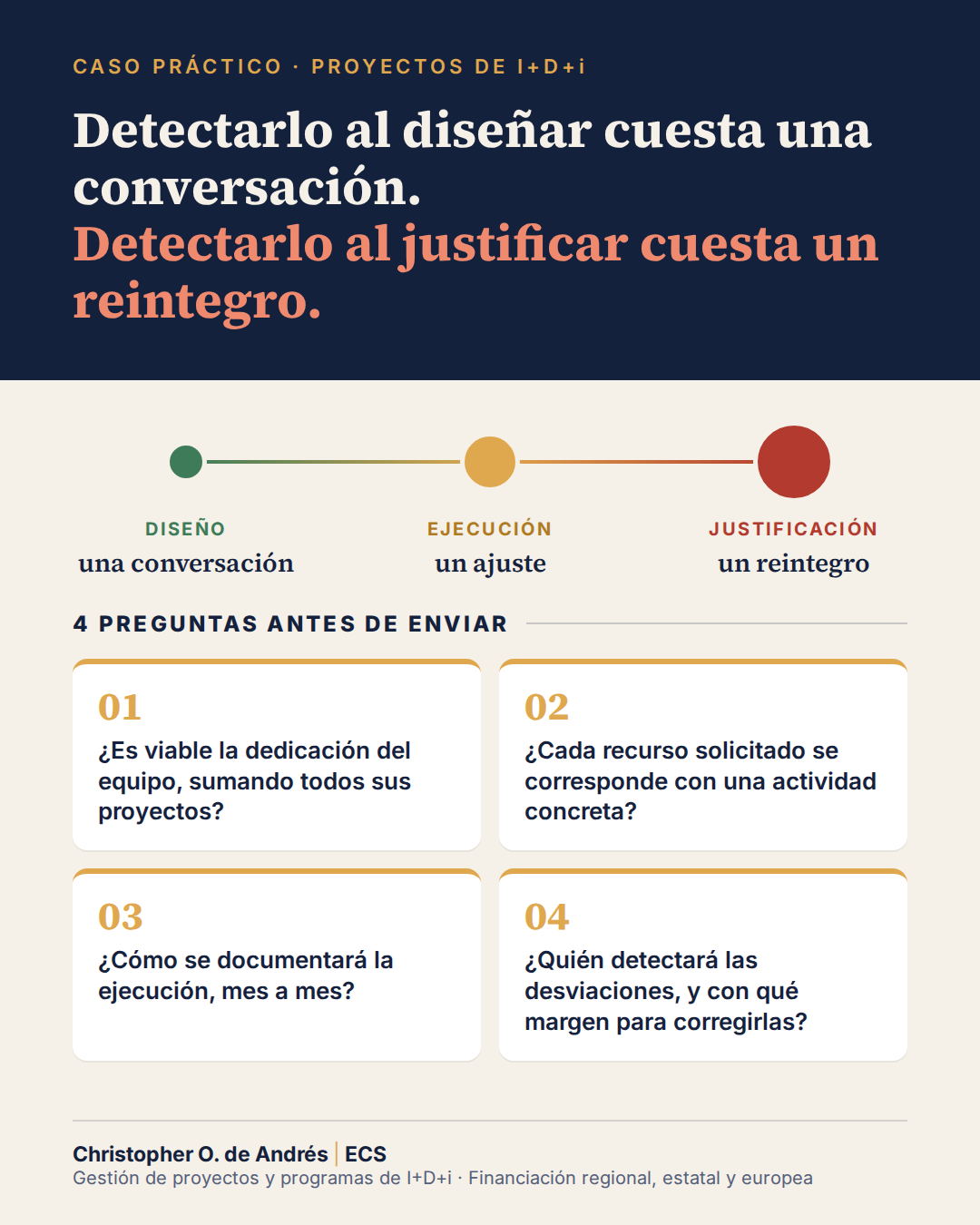
El coste de una desviación depende de cuándo se detecta
Un caso práctico breve.
Una investigadora prepara su tercera propuesta del año: una europea, una estatal y una regional. Cada una, por separado, es sólida. Pero si se suman las dedicaciones comprometidas, el resultado supera su jornada.
Nadie ha hecho nada mal. Simplemente, nadie ha cruzado los tres compromisos a la vez.
Por eso la justificación económica empieza en el diseño. En Horizon Europe, la calidad y eficiencia de la implementación es uno de los tres criterios de evaluación. La coherencia entre lo que se promete, los medios que se solicitan y la capacidad real de ejecutarlo forma parte de la calidad del proyecto.
Cuatro preguntas antes de enviar:
1. ¿Es viable la dedicación del equipo, sumando todos sus proyectos?
2. ¿Cada recurso solicitado se corresponde con una actividad concreta?
3. ¿Cómo se documentará la ejecución, mes a mes?
4. ¿Quién detectará las desviaciones, y con qué margen para corregirlas?
Aquí una oficina de apoyo a la investigación aporta lo que ningún proyecto aislado puede ver: acompaña al equipo investigador, traduce las condiciones de financiación en pautas claras y mantiene la visión de conjunto de compromisos, recursos y plazos.
Las reglas resultan útiles cuando cada persona sabe aplicarlas a su parte del proyecto.
Una propuesta bien construida responde a tres preguntas: ¿qué queremos conseguir?, ¿con qué medios? y ¿cómo acreditaremos lo realizado?
¿Cuál de las cuatro preguntas se queda sin respuesta más a menudo en vuestros proyectos?
Si tuvierais que añadir una quinta pregunta a la lista, ¿cuál sería? La mía estaría entre estas dos: ¿quién valida la dedicación antes de enviar la propuesta? y ¿qué compromiso se puede acreditar realmente con la documentación prevista?
Una investigadora prepara su tercera propuesta del año: una europea, una estatal y una regional. Cada una, por separado, es sólida. Pero si se suman las dedicaciones comprometidas, el resultado supera su jornada.
Nadie ha hecho nada mal. Simplemente, nadie ha cruzado los tres compromisos a la vez.
Por eso la justificación económica empieza en el diseño. En Horizon Europe, la calidad y eficiencia de la implementación es uno de los tres criterios de evaluación. La coherencia entre lo que se promete, los medios que se solicitan y la capacidad real de ejecutarlo forma parte de la calidad del proyecto.
Cuatro preguntas antes de enviar:
1. ¿Es viable la dedicación del equipo, sumando todos sus proyectos?
2. ¿Cada recurso solicitado se corresponde con una actividad concreta?
3. ¿Cómo se documentará la ejecución, mes a mes?
4. ¿Quién detectará las desviaciones, y con qué margen para corregirlas?
Aquí una oficina de apoyo a la investigación aporta lo que ningún proyecto aislado puede ver: acompaña al equipo investigador, traduce las condiciones de financiación en pautas claras y mantiene la visión de conjunto de compromisos, recursos y plazos.
Las reglas resultan útiles cuando cada persona sabe aplicarlas a su parte del proyecto.
Una propuesta bien construida responde a tres preguntas: ¿qué queremos conseguir?, ¿con qué medios? y ¿cómo acreditaremos lo realizado?
¿Cuál de las cuatro preguntas se queda sin respuesta más a menudo en vuestros proyectos?
Si tuvierais que añadir una quinta pregunta a la lista, ¿cuál sería? La mía estaría entre estas dos: ¿quién valida la dedicación antes de enviar la propuesta? y ¿qué compromiso se puede acreditar realmente con la documentación prevista?
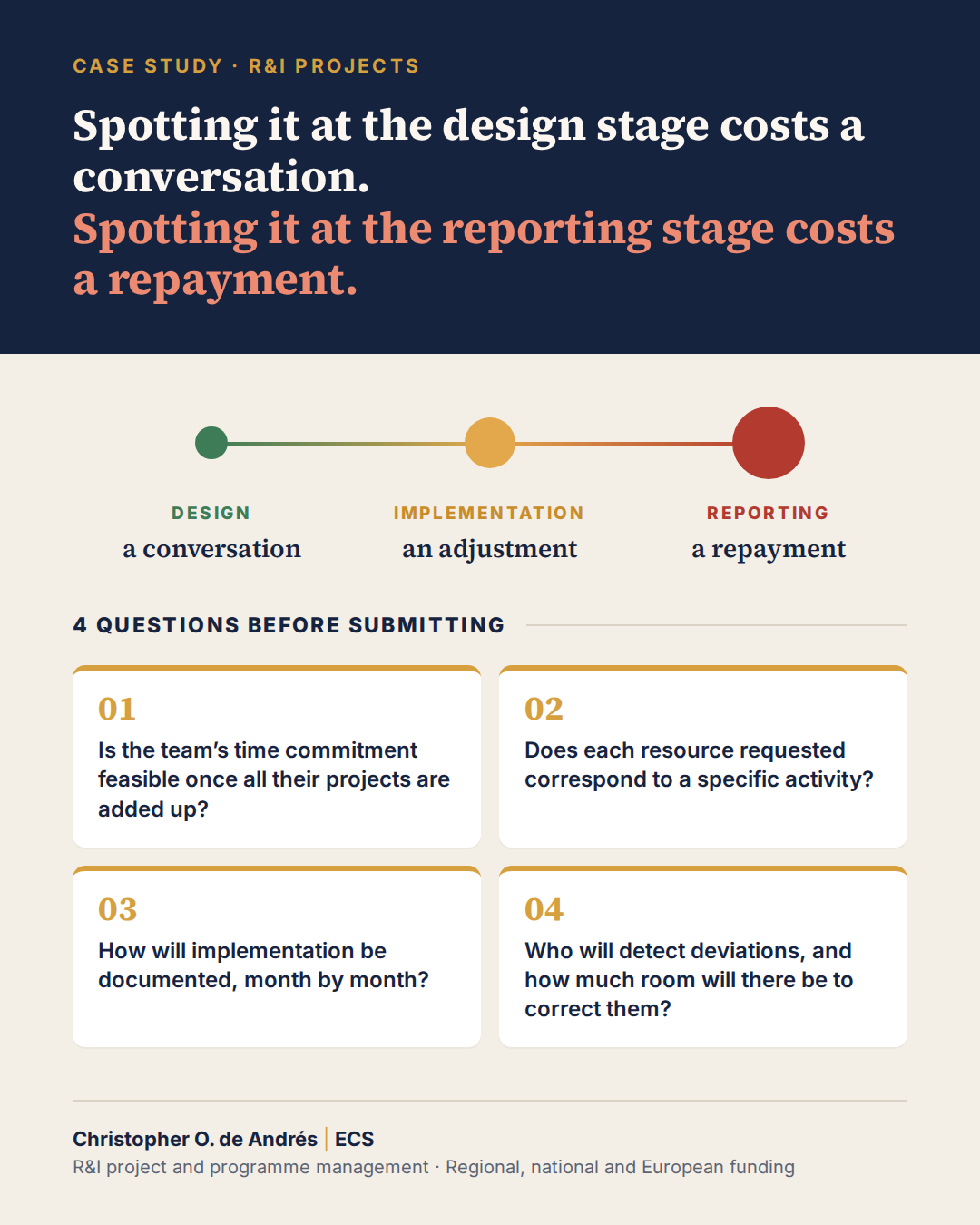
The cost of a deviation depends on when it is spotted
English version:
R&I proposals: spotting an over-commitment of staff time at the design stage costs a conversation. At the reporting stage, a repayment.
Before submitting a proposal, read it the way the evaluator will read it. Then read it the way the person who has to report on it will.
A brief case study.
A researcher is preparing her third proposal of the year: one European, one national and one regional. Each one, on its own, is solid. But add up the time committed across the three and the total exceeds her working hours.
Nobody has done anything wrong. It is simply that no one has cross-checked the three commitments together.
That is why financial reporting starts at the design stage. In Horizon Europe, the quality and efficiency of the implementation is one of the three evaluation criteria. Consistency between what is promised, the resources requested and the real capacity to deliver is part of the project's quality.
Four questions before submitting:
1. Is the team's time commitment feasible once all their projects are added up?
2. Does each resource requested correspond to a specific activity?
3. How will implementation be documented, month by month?
4. Who will detect deviations, and how much room will there be to correct them?
This is where a research support office contributes what no single project can see. It works alongside the research team, translates funding conditions into clear guidelines and keeps an overview of commitments, resources and deadlines.
Rules become useful when each person knows how to apply them to their own part of the project.
A well-built proposal answers three questions: what do we want to achieve, with what means, and how will we demonstrate what was done?
Which of the four questions most often goes unanswered in your projects?
If you had to add a fifth question to the list, what would it be? Mine would be one of these two: who validates the time commitment before the proposal is submitted, and what commitment can actually be evidenced with the planned documentation?
R&I proposals: spotting an over-commitment of staff time at the design stage costs a conversation. At the reporting stage, a repayment.
Before submitting a proposal, read it the way the evaluator will read it. Then read it the way the person who has to report on it will.
A brief case study.
A researcher is preparing her third proposal of the year: one European, one national and one regional. Each one, on its own, is solid. But add up the time committed across the three and the total exceeds her working hours.
Nobody has done anything wrong. It is simply that no one has cross-checked the three commitments together.
That is why financial reporting starts at the design stage. In Horizon Europe, the quality and efficiency of the implementation is one of the three evaluation criteria. Consistency between what is promised, the resources requested and the real capacity to deliver is part of the project's quality.
Four questions before submitting:
1. Is the team's time commitment feasible once all their projects are added up?
2. Does each resource requested correspond to a specific activity?
3. How will implementation be documented, month by month?
4. Who will detect deviations, and how much room will there be to correct them?
This is where a research support office contributes what no single project can see. It works alongside the research team, translates funding conditions into clear guidelines and keeps an overview of commitments, resources and deadlines.
Rules become useful when each person knows how to apply them to their own part of the project.
A well-built proposal answers three questions: what do we want to achieve, with what means, and how will we demonstrate what was done?
Which of the four questions most often goes unanswered in your projects?
If you had to add a fifth question to the list, what would it be? Mine would be one of these two: who validates the time commitment before the proposal is submitted, and what commitment can actually be evidenced with the planned documentation?
Posted by Christopher Oscar de Andrés, on Thursday, October 1st 2026 at 19:00
|
Comments (0)
Category


Recent posts

Archives
#AIGovernance #EUAIAct #StrategicTranslation #PublicAffairs #EuropeanPolicy #DigitalGovernance
#Gobernanza #GestiónDeCrisis #Resiliencia #CapacidadInstitucional #ProtecciónCivil
#HorizonEurope #EUFunding #ResearchAndInnovation #ScienceCommunication #ArtificialIntelligence #EuropeanCommission
#Team Management #Gestión de Equipo International Business Development #Gestión de Equipo Comercial
#TransatlanticRelations
#EUUSRelations
#PublicAffairs
#StrategicCommunication
#GlobalGovernance
#AIgovernance
#StrategicResilience
#USIndependenceDay hashtag#SpainUSRelations hashtag#TransatlanticRelations hashtag#PublicAffairs hashtag#StrategicCommunication hashtag#Diplomacy
10-N
ACNUR
ADHESIÓN DE CROACIA A LA UE
advertising / teleshopping spots
Africa
Agenda 2020 en España
AI
air accident in the Alps
Airbus A320 passengers
Al Jazeera
Angela Merkel
anti-Semitism
APEC Transacciones financieras
Asamblea General de Naciones Unidas
atentado terrorista en Colombia
audience persona
auto-expulsión explícita de la UE
Autor Christopher O de Andrés
Autoridad del Canal de Panamá (ACP)
Balcanes occidentales
Banco Central Europeo
Banco Central Europeo (BCE)
Boris Johnson
China
Comisión Europea
Coronavirus
Covid-19
COVID-19
Cybercrime
David Cameron
Editorial Universitas SA
EU Convention of Human Rights
European Commission
FMI
Henrique Capriles
Human Rights
ICAA
International Business Development
Jack Ma
Jean-Claude Juncker
Leadership
Mariano Rajoy
Obama
ONU
OSCE
The Council of Europe
Thomas Hammarberg
UNED
UNHCR
Unión Europea
Vladímir Putin