
Translating Complexity into Strategic Action
Why the future of EU–U.S. cooperation may depend less on alignment and more on the ability to translate different models of power.
There is a tension at the heart of the transatlantic relationship that is rarely discussed directly.
It is not a tension between allies. It is not a conflict of interests.
It is something more structural: two of the world's most influential democratic systems often approach progress through different institutional traditions.
The United States has built much of its technological influence around an ecosystem shaped by speed, entrepreneurship, risk-taking and the ability to scale innovation rapidly.
The European Union has built influence through a different model: creating frameworks designed to ensure that technological and economic progress develops alongside trust, accountability and democratic legitimacy.
Neither approach is sufficient on its own. Innovation without governance creates vulnerabilities. Governance without innovation creates stagnation. The future challenge is not choosing one model over the other. It is understanding how both can reinforce each other.

Beyond geography: the EU–U.S. relationship as an architecture of cooperation, resilience and strategic translation | Author: Christopher O. de Andrés
The architecture of trust - tested in real time.
The transatlantic partnership has been built on shared interests and shared values. But shared values do not mean identical institutions.
In a world where technology, data and artificial intelligence increasingly shape geopolitical influence, institutional differences increasingly matter alongside strategic objectives.
The past month has illustrated this with unusual clarity.
On May 20th 2026, the European Parliament and the European Council reached a provisional agreement with the United States that removes EU tariffs on U.S. industrial goods and caps most U.S. tariffs on EU products at 15% - averting an imminent tariff escalation and creating a new enforcement and safeguard architecture that will reshape transatlantic supply chains. The deal features a sunset clause expiring at the end of 2029 unless renewed and empowers the European Commission to suspend concessions if the U.S. fails to lift tariffs on European steel and aluminium products by the end of 2026.
Within the same period, the European Parliament approved amendments to the EU AI Act - simplifying compliance for providers while maintaining core safeguards, including bans on AI systems that generate non-consensual intimate imagery.
Two decisions. Same institutions. Same weeks. First about trade stability. Second about the conditions under which technology develops.
The connecting logic is identical: Europe is not seeking isolation. It is seeking the conditions under which openness remains sustainable. This is why concepts such as economic security, trusted partnerships and strategic resilience are becoming central to European policy - not as defensive reflexes, but as the architecture of long-term cooperation.
The transatlantic partnership has been built on shared interests and shared values. But shared values do not mean identical institutions.
In a world where technology, data and artificial intelligence increasingly shape geopolitical influence, institutional differences increasingly matter alongside strategic objectives.
The past month has illustrated this with unusual clarity.
On May 20th 2026, the European Parliament and the European Council reached a provisional agreement with the United States that removes EU tariffs on U.S. industrial goods and caps most U.S. tariffs on EU products at 15% - averting an imminent tariff escalation and creating a new enforcement and safeguard architecture that will reshape transatlantic supply chains. The deal features a sunset clause expiring at the end of 2029 unless renewed and empowers the European Commission to suspend concessions if the U.S. fails to lift tariffs on European steel and aluminium products by the end of 2026.
Within the same period, the European Parliament approved amendments to the EU AI Act - simplifying compliance for providers while maintaining core safeguards, including bans on AI systems that generate non-consensual intimate imagery.
Two decisions. Same institutions. Same weeks. First about trade stability. Second about the conditions under which technology develops.
The connecting logic is identical: Europe is not seeking isolation. It is seeking the conditions under which openness remains sustainable. This is why concepts such as economic security, trusted partnerships and strategic resilience are becoming central to European policy - not as defensive reflexes, but as the architecture of long-term cooperation.
Spain's strategic position - more complex than it appears.
This is where geography and history become strategic assets. And where the analysis requires precision.
Spain is not a passive observer of the EU–U.S. relationship. Four U.S. AEGIS destroyers are permanently deployed at the Naval Station in Rota, contributing to NATO's Ballistic Missile Defence System. Spain hosts NATO's Combined Air Operations Centre in Torrejón de Ardoz, its Counter-IED Centre of Excellence in Hoyo de Manzanares, and its Rapid Deployable Corps headquarters in Bétera. These are not symbolic arrangements. They are operational infrastructure on which U.S. and NATO defence capabilities depend.
And yet the relationship is not frictionless. In early 2026, a diplomatic dispute intensified between Washington and Madrid over the possible use of Spanish military bases for operations in the Middle East - with contradictory statements from both governments revealing the depth of the underlying tensions. Spain was the only NATO member that refused to commit to the Alliance's new defence spending target of 5% of GDP by 2035, securing instead a special exemption capping its military budget at approximately 2.1% of GDP.
This complexity is analytically important. A country that simultaneously provides critical U.S. military infrastructure and maintains independent foreign policy positions on conflicts the U.S. is directly involved in is not a simple ally. It is a relationship that requires constant, careful calibration - from both sides.
Spain's value to the transatlantic partnership is not merely logistical. Its Mediterranean position creates direct exposure to questions of energy, migration and regional stability. Its historical and institutional links with Latin America provide insight into political and economic dynamics in countries -Cuba, Venezuela, Brazil- that Washington monitors closely. Spanish diplomat Javier Colomina was appointed NATO Secretary General's Special Representative for the Southern Neighbourhood in July 2024 -a signal of Spain's emerging role as an institutional bridge between the Alliance's northern core and its southern periphery.
A country capable of engaging credibly across Brussels, Washington, Rabat, Latin America -as a Region- and Kyiv is not simply a mid-sized European economy. It is a node in a network that the transatlantic relationship needs to understand - and to maintain.
This is where geography and history become strategic assets. And where the analysis requires precision.
Spain is not a passive observer of the EU–U.S. relationship. Four U.S. AEGIS destroyers are permanently deployed at the Naval Station in Rota, contributing to NATO's Ballistic Missile Defence System. Spain hosts NATO's Combined Air Operations Centre in Torrejón de Ardoz, its Counter-IED Centre of Excellence in Hoyo de Manzanares, and its Rapid Deployable Corps headquarters in Bétera. These are not symbolic arrangements. They are operational infrastructure on which U.S. and NATO defence capabilities depend.
And yet the relationship is not frictionless. In early 2026, a diplomatic dispute intensified between Washington and Madrid over the possible use of Spanish military bases for operations in the Middle East - with contradictory statements from both governments revealing the depth of the underlying tensions. Spain was the only NATO member that refused to commit to the Alliance's new defence spending target of 5% of GDP by 2035, securing instead a special exemption capping its military budget at approximately 2.1% of GDP.
This complexity is analytically important. A country that simultaneously provides critical U.S. military infrastructure and maintains independent foreign policy positions on conflicts the U.S. is directly involved in is not a simple ally. It is a relationship that requires constant, careful calibration - from both sides.
Spain's value to the transatlantic partnership is not merely logistical. Its Mediterranean position creates direct exposure to questions of energy, migration and regional stability. Its historical and institutional links with Latin America provide insight into political and economic dynamics in countries -Cuba, Venezuela, Brazil- that Washington monitors closely. Spanish diplomat Javier Colomina was appointed NATO Secretary General's Special Representative for the Southern Neighbourhood in July 2024 -a signal of Spain's emerging role as an institutional bridge between the Alliance's northern core and its southern periphery.
A country capable of engaging credibly across Brussels, Washington, Rabat, Latin America -as a Region- and Kyiv is not simply a mid-sized European economy. It is a node in a network that the transatlantic relationship needs to understand - and to maintain.

Spain’s strategic position: linking European priorities with U.S. engagement through diplomacy, security and transatlantic cooperation | Author: Christopher O. de Andrés
The translation challenge.
The transatlantic relationship requires a capability that is often overlooked: translation.
Not linguistic translation. Institutional translation - the ability to take a policy priority that makes complete sense within one political system and make it understandable, actionable and legitimate within another. It is the capacity to understand not only what different actors decide, but why they reach different conclusions.
When the European Union regulates emerging technologies, it is applying a governance approach rooted in fundamental rights, accountability and public trust. When the United States prioritises technological leadership, it reflects a tradition focused on entrepreneurship, competition and market dynamism. When Spain maintains an independent position on a military conflict while hosting U.S. bases on its territory, it is not being incoherent. It is navigating the space between alliance obligations and democratic legitimacy - a space that every European ally is managing, with varying degrees of visibility.
- The challenge is not eliminating these differences. It is making them productive.
That requires institutions and professionals capable of understanding both systems from the inside: their incentives, their constraints, the historical and political reasons behind different approaches - and the analytical capacity to identify where they diverge, where they can be made to converge, and where the divergence itself is strategically meaningful.
The transatlantic relationship requires a capability that is often overlooked: translation.
Not linguistic translation. Institutional translation - the ability to take a policy priority that makes complete sense within one political system and make it understandable, actionable and legitimate within another. It is the capacity to understand not only what different actors decide, but why they reach different conclusions.
When the European Union regulates emerging technologies, it is applying a governance approach rooted in fundamental rights, accountability and public trust. When the United States prioritises technological leadership, it reflects a tradition focused on entrepreneurship, competition and market dynamism. When Spain maintains an independent position on a military conflict while hosting U.S. bases on its territory, it is not being incoherent. It is navigating the space between alliance obligations and democratic legitimacy - a space that every European ally is managing, with varying degrees of visibility.
- The challenge is not eliminating these differences. It is making them productive.
That requires institutions and professionals capable of understanding both systems from the inside: their incentives, their constraints, the historical and political reasons behind different approaches - and the analytical capacity to identify where they diverge, where they can be made to converge, and where the divergence itself is strategically meaningful.
What the next strategic cycle demands.
The period from June 2026 to December 2030 will not be defined by whether Europe and the United States remain partners. They will.
The defining question will be whether they can translate partnership into coordinated action on the issues that will shape the next strategic cycle: artificial intelligence governance, critical supply chain resilience, energy security, digital infrastructure, defence cooperation - and the management of relationships with countries in the Global South that neither side can afford to lose.
Building bridges in this environment is not a metaphor for goodwill. It is a practical capability. It requires analytical rigour, institutional knowledge, a network of contacts across public and private sectors, and the ability to produce reporting and analysis that is both factually grounded and strategically relevant.
The future of transatlantic cooperation will depend not only on who has influence. It will depend on who can build the frameworks through which influence becomes coordinated action.
And in that process, countries such as Spain - with their particular combination of strategic assets and political complexities - may have a role that deserves considerably more analytical attention than they currently receive.
The period from June 2026 to December 2030 will not be defined by whether Europe and the United States remain partners. They will.
The defining question will be whether they can translate partnership into coordinated action on the issues that will shape the next strategic cycle: artificial intelligence governance, critical supply chain resilience, energy security, digital infrastructure, defence cooperation - and the management of relationships with countries in the Global South that neither side can afford to lose.
Building bridges in this environment is not a metaphor for goodwill. It is a practical capability. It requires analytical rigour, institutional knowledge, a network of contacts across public and private sectors, and the ability to produce reporting and analysis that is both factually grounded and strategically relevant.
The future of transatlantic cooperation will depend not only on who has influence. It will depend on who can build the frameworks through which influence becomes coordinated action.
And in that process, countries such as Spain - with their particular combination of strategic assets and political complexities - may have a role that deserves considerably more analytical attention than they currently receive.
Reference framework.
This analysis draws on recent policy developments and institutional frameworks shaping the transatlantic agenda, including the European Union’s approach to strategic autonomy, economic security and artificial intelligence governance; U.S. strategies focused on technological leadership, innovation capacity and national security resilience; and NATO’s evolving priorities regarding collective defence and emerging security challenges.
Recent assessments and policy frameworks from institutions such as the European Commission, the European External Action Service, the U.S. Department of State, NATO and the OECD increasingly highlight a common trend: future competitiveness and international influence will depend not only on technological capability or economic strength, but on the ability to build trusted frameworks for cooperation across different institutional models.
Christopher O. de Andrés is a strategic communications and public affairs professional with over 20 years of experience working across European institutions, international organisations and multilateral environments. His current analytical work explores how Artificial Intelligence is reshaping strategic competition, security policy and transatlantic cooperation.
This analysis draws on recent policy developments and institutional frameworks shaping the transatlantic agenda, including the European Union’s approach to strategic autonomy, economic security and artificial intelligence governance; U.S. strategies focused on technological leadership, innovation capacity and national security resilience; and NATO’s evolving priorities regarding collective defence and emerging security challenges.
Recent assessments and policy frameworks from institutions such as the European Commission, the European External Action Service, the U.S. Department of State, NATO and the OECD increasingly highlight a common trend: future competitiveness and international influence will depend not only on technological capability or economic strength, but on the ability to build trusted frameworks for cooperation across different institutional models.
Christopher O. de Andrés is a strategic communications and public affairs professional with over 20 years of experience working across European institutions, international organisations and multilateral environments. His current analytical work explores how Artificial Intelligence is reshaping strategic competition, security policy and transatlantic cooperation.
Posted by Christopher Oscar de Andrés, on Monday, June 22nd 2026 at 10:15
|
Comments (0)
Europol’s 2019 EU Terrorism Situation and Trend Report (TE-SAT), a product requested by the European Parliament and published today, provides a concise overview of the nature of the terrorist threat the EU faced in 2018.
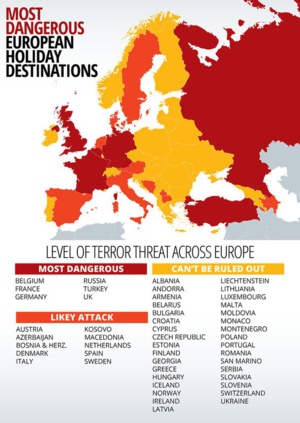
Source: Daily Express. Holidays 2019: The FCO has mapped the most dangerous holiday destinations in Europe
New EU Terrorism Situation and Trend Report describes terrorist incidents and activities on European soil.
In 2018, terrorism continued to represent a major security threat in EU Member States. Horrific attacks killed thirteen people and injured many more. A stark increase in the number of arrests linked to right-wing extremism, although still relatively low, indicates that extremists of diverging orientation increasingly consider violence as a justified means of confrontation. Compared to 2017, the number of attacks and victims in the EU dropped significantly. However, the number of disrupted jihadist terrorist plots increased substantially. The level of threat from terrorism has therefore not diminished; if anything it has become more complex.
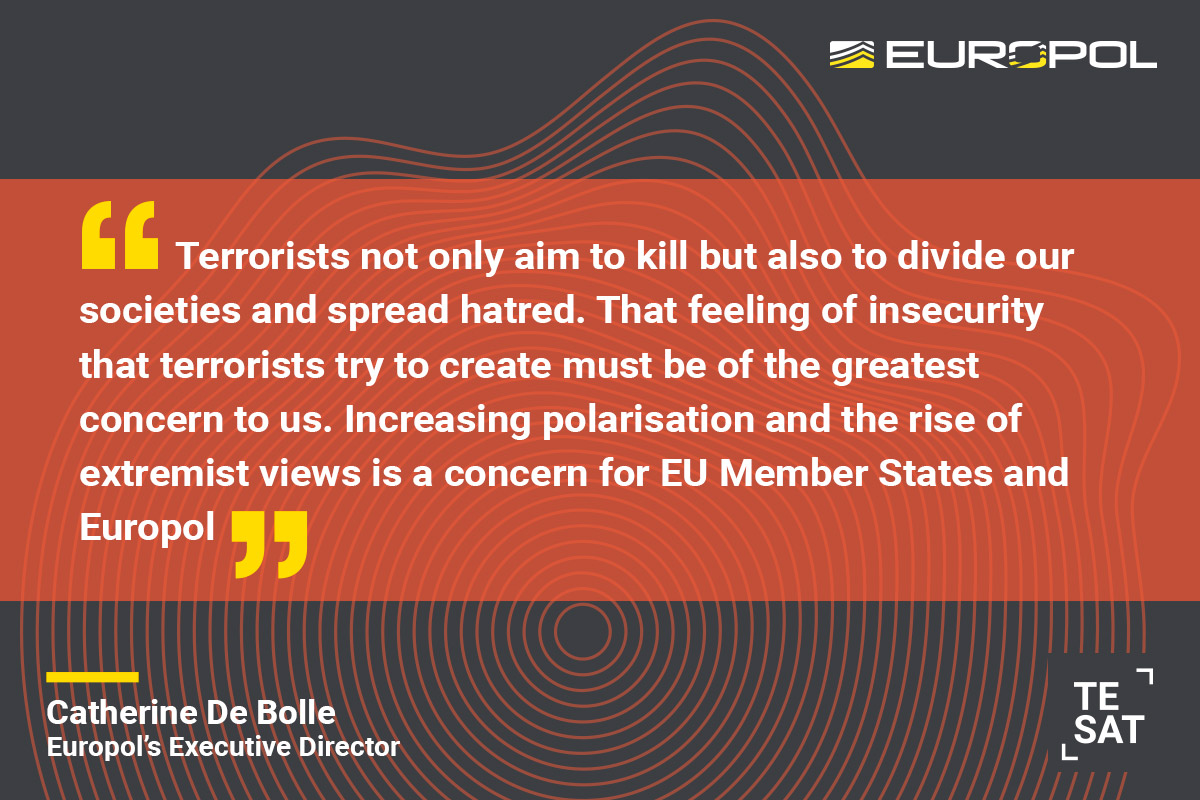
“Terrorists not only aim to kill but also to divide our societies and spread hatred. That feeling of insecurity that terrorists try to create must be of the greatest concern to us. Increasing polarisation and the rise of extremist views is a concern for EU Member States and Europol”, said Catherine De Bolle, Europol’s Executive Director. “I am confident that the efforts of law enforcement, security services, public authorities, private companies and civil society have substantially contributed to the decrease in terrorist violence in the EU. Terrorism affects real people and that is why we will never stop our efforts to fight terrorism and to prevent victims.”
In 2018, terrorism continued to represent a major security threat in EU Member States. Horrific attacks killed thirteen people and injured many more. A stark increase in the number of arrests linked to right-wing extremism, although still relatively low, indicates that extremists of diverging orientation increasingly consider violence as a justified means of confrontation. Compared to 2017, the number of attacks and victims in the EU dropped significantly. However, the number of disrupted jihadist terrorist plots increased substantially. The level of threat from terrorism has therefore not diminished; if anything it has become more complex.
“Terrorists not only aim to kill but also to divide our societies and spread hatred. That feeling of insecurity that terrorists try to create must be of the greatest concern to us. Increasing polarisation and the rise of extremist views is a concern for EU Member States and Europol”, said Catherine De Bolle, Europol’s Executive Director. “I am confident that the efforts of law enforcement, security services, public authorities, private companies and civil society have substantially contributed to the decrease in terrorist violence in the EU. Terrorism affects real people and that is why we will never stop our efforts to fight terrorism and to prevent victims.”
Dimitris Avramopoulos, EU Commissioner for Migration, Home Affairs and Citizenship, added: “While Member States together with Europol have become increasingly effective in preventing terrorist attacks on European soil over the past years, the terrorist threat is still there. Today’s report shows that the threat of violent extremism, from whichever ideology, is heterogeneous and nimble, and continues to thrive off the internet. More than ever, the EU needs to continue its counter-terrorist measures, information sharing and law enforcement cooperation both on the ground and online, with the crucial support of Europol.”
Julian King, EU Commissioner for the Security Union, concluded: “Europol’s report underlines that terrorism still poses a real and present danger to the EU. While our joint work to disrupt and prevent attacks seems to be having a positive effect, the enduring threat posed by Islamist groups like Da’esh, along with the rise of far right-wing extremist violence, clearly shows that there is still much to be done – notably in tackling the scourge of terrorist content online.”
Julian King, EU Commissioner for the Security Union, concluded: “Europol’s report underlines that terrorism still poses a real and present danger to the EU. While our joint work to disrupt and prevent attacks seems to be having a positive effect, the enduring threat posed by Islamist groups like Da’esh, along with the rise of far right-wing extremist violence, clearly shows that there is still much to be done – notably in tackling the scourge of terrorist content online.”
Source: Europol's press release. Date 27 June 2019
MAIN TRENDS
>Thirteen people lost their lives as a result of terrorist attacks in the EU in 2018. All the attacks were jihadist in nature and committed by individuals acting alone, targeting civilians and symbols of authority. Often, the motivation of the perpetrator and the links to other radicalised individuals or terrorist groups remained unclear. Mental health issues contributed to the complexity of the phenomenon. Completed jihadist attacks were carried out using firearms and unsophisticated, readily available weapons (e.g. knives).
>In addition to the completed attacks, EU Member States reported 16 foiled jihadist terrorist plots, illustrating the effectiveness of counter-terrorism efforts. The significant number of thwarted attacks and the so-called Islamic State’s continued intent to perpetrate attacks outside conflict zones indicate that the threat level across the EU remains high.
>Three disrupted terrorist plots in the EU in 2018 included the attempted production and use of explosives and chemical or biological materials. There was also an increase in the use of pyrotechnic mixtures to produce explosive devices in jihadist plots. A general increase of CBRN terrorist propaganda, tutorials and threats was observed and the barrier for gaining knowledge on the use of CBRN weapons has decreased. Closed forums proposed possible modi operandi, shared instructions to produce and disperse various agents and identify high-profile targets.
>In total, EU Member States reported 129 foiled, failed and completed terrorist attacks in 2018. The total number of attacks decreased after a sharp spike in 2017 (205), primarily because of the decrease in the reported ethno-nationalist and separatist-related incidents. Still, ethno-nationalist and separatist terrorist attacks continue to greatly outnumber other types of terrorist attacks (83 out of 129).
>In total 1056 individuals were arrested in the EU in 2018 on suspicion of terrorism-related offences (2017: 1219). One fifth of them were women. The number of arrests linked to right-wing terrorism remained relatively low (44 in 2018) and was limited to a small number of countries but increased for the third time in a row, effectively doubling for the second year in a row (2016: 12, 2017: 20). Right-wing extremists prey on fears of perceived attempts to Islamicise society and loss of national identity. The violent right-wing extremist scene is very heterogeneous across EU Member States.
>The number of European foreign terrorist fighters travelling, or attempting to travel to conflict zones was very low in 2018. The focus of jihadist networks has shifted towards carrying out activities inside the EU. The number of individuals returning to the EU also remained very low. Hundreds of European citizens – including women and minors, mainly of very young age- remain in detention in the Iraqi and Syrian conflict zone. All men and some women are believed to have received weapons training, with men also acquiring combat experience. While minors are essentially victims, there are concerns among EU Member States that they may have been exposed to indoctrination and training in former IS territories and may pose a potential future threat.
There is continued concern that individuals with a criminal background, including those currently imprisoned, are vulnerable to indoctrination and might engage in terrorist activities.
>Despite the shrinking of its physical footprint, IS succeeded in maintaining an online presence largely thanks to unofficial supporter networks and pro-IS media outlets. Pro-IS and pro-al-Qaeda channels promoted the use of alternative platforms and open source technologies. While IS online propaganda remained technologically advanced, and hackers appeared to be knowledgeable in encrypted communication tools, the groups’ cyber-attack capabilities and techniques were rudimentary. In addition, no other terrorist group with a demonstrated capacity to carry out effective cyber-attacks emerged in 2018.
>EU Member States assess that the diminishing territorial control of IS is likely to be replaced by increased al-Qaeda efforts to reclaim power and influence in some areas. Al-Qaeda affiliates exploited political grievances on the local and international level, including in messages directed at European audiences.
The report also provides an overview of the terrorist situation outside the EU, including in conflict zones like Afghanistan, Iraq, Libya and Syria but also the Americas, Australia, Russia and Central Asia, West Africa, South Asia etc.
>Thirteen people lost their lives as a result of terrorist attacks in the EU in 2018. All the attacks were jihadist in nature and committed by individuals acting alone, targeting civilians and symbols of authority. Often, the motivation of the perpetrator and the links to other radicalised individuals or terrorist groups remained unclear. Mental health issues contributed to the complexity of the phenomenon. Completed jihadist attacks were carried out using firearms and unsophisticated, readily available weapons (e.g. knives).
>In addition to the completed attacks, EU Member States reported 16 foiled jihadist terrorist plots, illustrating the effectiveness of counter-terrorism efforts. The significant number of thwarted attacks and the so-called Islamic State’s continued intent to perpetrate attacks outside conflict zones indicate that the threat level across the EU remains high.
>Three disrupted terrorist plots in the EU in 2018 included the attempted production and use of explosives and chemical or biological materials. There was also an increase in the use of pyrotechnic mixtures to produce explosive devices in jihadist plots. A general increase of CBRN terrorist propaganda, tutorials and threats was observed and the barrier for gaining knowledge on the use of CBRN weapons has decreased. Closed forums proposed possible modi operandi, shared instructions to produce and disperse various agents and identify high-profile targets.
>In total, EU Member States reported 129 foiled, failed and completed terrorist attacks in 2018. The total number of attacks decreased after a sharp spike in 2017 (205), primarily because of the decrease in the reported ethno-nationalist and separatist-related incidents. Still, ethno-nationalist and separatist terrorist attacks continue to greatly outnumber other types of terrorist attacks (83 out of 129).
>In total 1056 individuals were arrested in the EU in 2018 on suspicion of terrorism-related offences (2017: 1219). One fifth of them were women. The number of arrests linked to right-wing terrorism remained relatively low (44 in 2018) and was limited to a small number of countries but increased for the third time in a row, effectively doubling for the second year in a row (2016: 12, 2017: 20). Right-wing extremists prey on fears of perceived attempts to Islamicise society and loss of national identity. The violent right-wing extremist scene is very heterogeneous across EU Member States.
>The number of European foreign terrorist fighters travelling, or attempting to travel to conflict zones was very low in 2018. The focus of jihadist networks has shifted towards carrying out activities inside the EU. The number of individuals returning to the EU also remained very low. Hundreds of European citizens – including women and minors, mainly of very young age- remain in detention in the Iraqi and Syrian conflict zone. All men and some women are believed to have received weapons training, with men also acquiring combat experience. While minors are essentially victims, there are concerns among EU Member States that they may have been exposed to indoctrination and training in former IS territories and may pose a potential future threat.
There is continued concern that individuals with a criminal background, including those currently imprisoned, are vulnerable to indoctrination and might engage in terrorist activities.
>Despite the shrinking of its physical footprint, IS succeeded in maintaining an online presence largely thanks to unofficial supporter networks and pro-IS media outlets. Pro-IS and pro-al-Qaeda channels promoted the use of alternative platforms and open source technologies. While IS online propaganda remained technologically advanced, and hackers appeared to be knowledgeable in encrypted communication tools, the groups’ cyber-attack capabilities and techniques were rudimentary. In addition, no other terrorist group with a demonstrated capacity to carry out effective cyber-attacks emerged in 2018.
>EU Member States assess that the diminishing territorial control of IS is likely to be replaced by increased al-Qaeda efforts to reclaim power and influence in some areas. Al-Qaeda affiliates exploited political grievances on the local and international level, including in messages directed at European audiences.
The report also provides an overview of the terrorist situation outside the EU, including in conflict zones like Afghanistan, Iraq, Libya and Syria but also the Americas, Australia, Russia and Central Asia, West Africa, South Asia etc.
More details and context can be found in the Europol’s 2019 EU Terrorism Situation and Trend Report (TE-SAT).
Category


Recent posts

Archives
#AIGovernance #EUAIAct #StrategicTranslation #PublicAffairs #EuropeanPolicy #DigitalGovernance
#HorizonEurope #EUFunding #ResearchAndInnovation #ScienceCommunication #ArtificialIntelligence #EuropeanCommission
#Inteligencia_Artificial #Gestión_del_Riesgo
#Gestión_de_Crisis #ProjectManagement #ForoEconómicoMundial #AgenciaEspacialEuropea
#PMI
#PM
#Desarrollo_de_Negocio_internacional
#TransatlanticRelations
#EUUSRelations
#PublicAffairs
#StrategicCommunication
#GlobalGovernance
#AIgovernance
#StrategicResilience
#USIndependenceDay hashtag#SpainUSRelations hashtag#TransatlanticRelations hashtag#PublicAffairs hashtag#StrategicCommunication hashtag#Diplomacy
10-N
2019 European election results
ACNUR
advertising / teleshopping spots
Africa
Agenda 2020 en España
AI
air accident in the Alps
Airbus A320 passengers
Al Jazeera
al Qaeda
Angela Merkel
APEC Transacciones financieras
Asamblea General de Naciones Unidas
atentado terrorista en Colombia
audience persona
auto-expulsión explícita de la UE
Autor Christopher O de Andrés
Autoridad del Canal de Panamá (ACP)
Balcanes occidentales
Banco Central Europeo
Banco Central Europeo (BCE)
Banco Mundial
Boris Johnson
China
Comisión Europea
Coronavirus
Covid-19
COVID-19
Cybercrime
David Cameron
Editorial Universitas SA
EU Convention of Human Rights
European Commission
FMI
Henrique Capriles
Human Rights
ICAA
International Business Development
Jack Ma
Jean-Claude Juncker
Leadership
Mariano Rajoy
Obama
ONU
OSCE
The Council of Europe
Thomas Hammarberg
UNED
UNHCR
Unión Europea
Vladímir Putin