
Translating Complexity into Strategic Action
Why the most resilient organisations are dismantling the silo between operational governance and strategic communication - and what that means for leadership in complex environments.
author: Christopher O. de Andres | Editor ECS
A reflection on convergence, complexity and the next generation of organisational capability
Something is shifting in how the most effective organisations manage complexity.
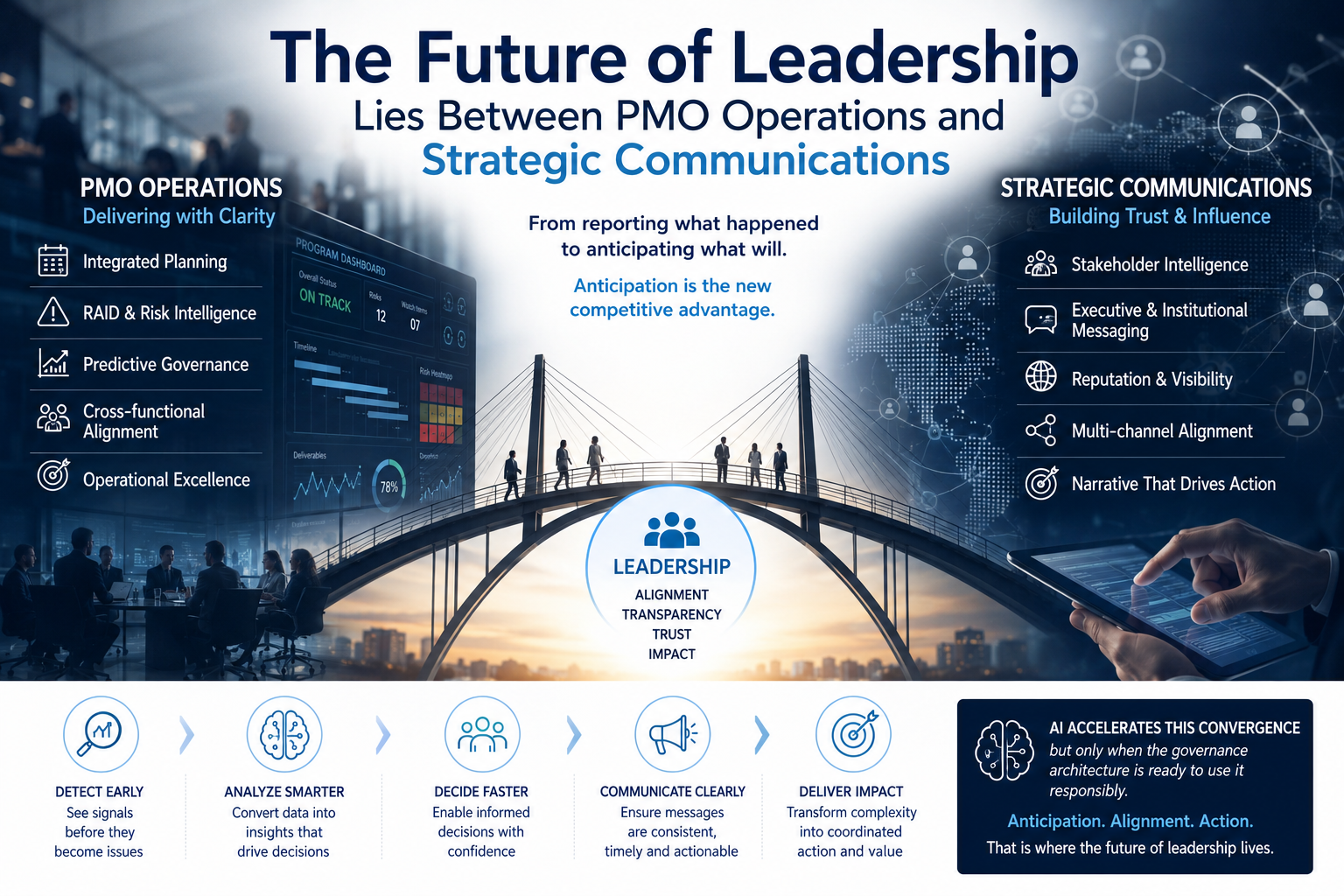
It is not a technological shift - though technology is accelerating it. It is a structural one. The organisations navigating transformation most successfully are those that have quietly begun to dismantle one of the most persistent silos in modern management: the separation between operational governance and strategic communication.
For decades, these two disciplines have evolved in parallel. PMO operations developed increasingly sophisticated methodologies - RAID management, integrated planning, governance frameworks, delivery oversight. Strategic communications built its own architecture - stakeholder mapping, narrative positioning, reputation management, institutional engagement. Both disciplines matured. Both became more rigorous. And both, in doing so, became more isolated from each other.
That isolation is now a liability.
Something is shifting in how the most effective organisations manage complexity.
It is not a technological shift - though technology is accelerating it. It is a structural one. The organisations navigating transformation most successfully are those that have quietly begun to dismantle one of the most persistent silos in modern management: the separation between operational governance and strategic communication.
For decades, these two disciplines have evolved in parallel. PMO operations developed increasingly sophisticated methodologies - RAID management, integrated planning, governance frameworks, delivery oversight. Strategic communications built its own architecture - stakeholder mapping, narrative positioning, reputation management, institutional engagement. Both disciplines matured. Both became more rigorous. And both, in doing so, became more isolated from each other.
That isolation is now a liability.
When complexity demands convergence
In highly regulated, multi-stakeholder environments -healthcare, international institutions, financial services, infrastructure, high-tech- the cost of misalignment between governance and communication is no longer abstract.
A programme can be technically on track and reputationally off course simultaneously. A governance structure can be internally coherent and externally opaque. A risk can be identified, escalated and resolved within a RAID log - and never meaningfully communicated to the stakeholders whose trust determines whether the programme survives its next review.
The gap between what organisations manage and what they communicate about what they manage is, increasingly, where transformation fails.
Not in the technology. Not in the methodology. In the space between them.
In highly regulated, multi-stakeholder environments -healthcare, international institutions, financial services, infrastructure, high-tech- the cost of misalignment between governance and communication is no longer abstract.
A programme can be technically on track and reputationally off course simultaneously. A governance structure can be internally coherent and externally opaque. A risk can be identified, escalated and resolved within a RAID log - and never meaningfully communicated to the stakeholders whose trust determines whether the programme survives its next review.
The gap between what organisations manage and what they communicate about what they manage is, increasingly, where transformation fails.
Not in the technology. Not in the methodology. In the space between them.
The emergence of a new leadership capability
What is emerging -slowly, unevenly, but clearly- is a new kind of organisational leadership that operates across this space. It is not a hybrid role in the traditional sense. It is not a PMO director who also writes press releases, or a communications manager who attends governance forums. It is something more fundamental: a leadership capability that treats operational governance and stakeholder communication as two expressions of the same strategic intention.
This capability requires, simultaneously:
1. The discipline to build governance structures that are transparent by design - not as a reporting obligation, but as a trust-building mechanism.
2. The judgment to translate operational complexity into narratives that decision-makers can act on - at every level of the organisation.
3. The foresight to anticipate where the gap between internal reality and external perception will widen - before it becomes a crisis.
And increasingly, the literacy to deploy AI not as an automation layer, but as a decision-support and alignment capability that makes both governance and communication more predictive, more consistent and more human.
What is emerging -slowly, unevenly, but clearly- is a new kind of organisational leadership that operates across this space. It is not a hybrid role in the traditional sense. It is not a PMO director who also writes press releases, or a communications manager who attends governance forums. It is something more fundamental: a leadership capability that treats operational governance and stakeholder communication as two expressions of the same strategic intention.
This capability requires, simultaneously:
1. The discipline to build governance structures that are transparent by design - not as a reporting obligation, but as a trust-building mechanism.
2. The judgment to translate operational complexity into narratives that decision-makers can act on - at every level of the organisation.
3. The foresight to anticipate where the gap between internal reality and external perception will widen - before it becomes a crisis.
And increasingly, the literacy to deploy AI not as an automation layer, but as a decision-support and alignment capability that makes both governance and communication more predictive, more consistent and more human.
AI as connector, not replacement
The strategic relevance of AI in this context is frequently misunderstood.
In PMO environments, AI is most valuable not when it automates task tracking, but when it enables predictive risk identification - surfacing patterns across programme data that human oversight would catch too late. In communications, AI is most valuable not when it generates content, but when it analyses stakeholder sentiment, maps influence networks and identifies reputational risk before it crystallises.
In both cases, the value of AI is not replacement. It is anticipation.
But anticipation, at organisational scale, requires something AI cannot provide on its own: a governance architecture that is ready to act on what it foresees, and a communication capability that can translate that foresight into trust.
The organisations that will lead the next decade of transformation will not be those with the most sophisticated AI. They will be those that have built the human infrastructure to use it wisely.
The strategic relevance of AI in this context is frequently misunderstood.
In PMO environments, AI is most valuable not when it automates task tracking, but when it enables predictive risk identification - surfacing patterns across programme data that human oversight would catch too late. In communications, AI is most valuable not when it generates content, but when it analyses stakeholder sentiment, maps influence networks and identifies reputational risk before it crystallises.
In both cases, the value of AI is not replacement. It is anticipation.
But anticipation, at organisational scale, requires something AI cannot provide on its own: a governance architecture that is ready to act on what it foresees, and a communication capability that can translate that foresight into trust.
The organisations that will lead the next decade of transformation will not be those with the most sophisticated AI. They will be those that have built the human infrastructure to use it wisely.
A closing reflection
The convergence between PMO operations and strategic communications is not a trend. It is a response to a structural reality: that in complex, high-stakes environments, operational excellence and reputational integrity are not separate objectives. They are the same objective, pursued through different but increasingly inseparable means.
The leaders who understand this -and who can operate credibly across both domains- will not simply be more effective in their current roles.
They will define what effective leadership looks like in the decade ahead.
*** Curious to hear how others are navigating this convergence in their own organisations - whether in healthcare, institutional environments, or other complex and regulated sectors.
The convergence between PMO operations and strategic communications is not a trend. It is a response to a structural reality: that in complex, high-stakes environments, operational excellence and reputational integrity are not separate objectives. They are the same objective, pursued through different but increasingly inseparable means.
The leaders who understand this -and who can operate credibly across both domains- will not simply be more effective in their current roles.
They will define what effective leadership looks like in the decade ahead.
*** Curious to hear how others are navigating this convergence in their own organisations - whether in healthcare, institutional environments, or other complex and regulated sectors.
Tags :
AI
Governance
Healthcare Transformation
Leadership
PMO
Stakeholder Engagement
Strategic Communications
Thought Leadership
Posted by Christopher Oscar de Andrés, on Wednesday, May 13th 2026 at 07:33
|
Comments (0)
Category


Recent posts

Archives
#AIGovernance #EUAIAct #StrategicTranslation #PublicAffairs #EuropeanPolicy #DigitalGovernance
#HorizonEurope #EUFunding #ResearchAndInnovation #ScienceCommunication #ArtificialIntelligence #EuropeanCommission
#Inteligencia_Artificial #Gestión_del_Riesgo
#Gestión_de_Crisis #ProjectManagement #ForoEconómicoMundial #AgenciaEspacialEuropea
#PMI
#PM
#Desarrollo_de_Negocio_internacional
#TransatlanticRelations
#EUUSRelations
#PublicAffairs
#StrategicCommunication
#GlobalGovernance
#AIgovernance
#StrategicResilience
#USIndependenceDay hashtag#SpainUSRelations hashtag#TransatlanticRelations hashtag#PublicAffairs hashtag#StrategicCommunication hashtag#Diplomacy
10-N
2019 European election results
ACNUR
advertising / teleshopping spots
Africa
Agenda 2020 en España
AI
air accident in the Alps
Airbus A320 passengers
Al Jazeera
al Qaeda
Angela Merkel
APEC Transacciones financieras
Asamblea General de Naciones Unidas
atentado terrorista en Colombia
audience persona
auto-expulsión explícita de la UE
Autor Christopher O de Andrés
Autoridad del Canal de Panamá (ACP)
Balcanes occidentales
Banco Central Europeo
Banco Central Europeo (BCE)
Banco Mundial
Boris Johnson
China
Comisión Europea
Coronavirus
Covid-19
COVID-19
Cybercrime
David Cameron
Editorial Universitas SA
EU Convention of Human Rights
European Commission
FMI
Henrique Capriles
Human Rights
ICAA
International Business Development
Jack Ma
Jean-Claude Juncker
Leadership
Mariano Rajoy
Obama
ONU
OSCE
The Council of Europe
Thomas Hammarberg
UNED
UNHCR
Unión Europea
Vladímir Putin